
The First Luxury: Why Mediterranean Shell Bracelets Ruled Antiquity
Close your eyes. Transport yourself to the Black Sea coast, 4600 BC. The air is thick with the smoke of ritual fires. You are standing at the edge of a grave that will one day be known to archaeologists as "Grave 43" in the Varna Necropolis. The man being lowered into the ground is a king, a high priest, a figure of immense power.
 Grave 43, Varna Necropolis,
His mourners have covered him in gold. Six kilograms of it. There are golden scepters, golden beads, golden appliques sewn into his garments. It is an obscene display of mineral wealth, enough to buy an army. But look closer. Look at his right arm. Resting against the cold, yellow metal is a bracelet made of Spondylus shell.
It is imperfect. It is chalky. It is a vivid, fleshy orange. And here is the secret that history whispers: to the people standing around that grave, the shell was likely worth more than the gold. The gold was local; it came from the nearby riverbeds. The shell came from the Aegean Sea, hundreds of kilometers away. It had to be dived for, carried over mountains, traded through hostile territories. It was not just jewelry. It was a piece of a distant, mythical world.
We often think of luxury as a modern invention—a logo, a red sole, a leather bag. But the human desire to adorn the body with rare, beautiful objects is primal. For the ancient Mediterranean people, the shell bracelet was the ultimate status symbol. It was harder to procure than stone, more fragile than bone, and carried the mysterious, rhythmic energy of the deep ocean.
At ShellVibe, we aren't just selling jewelry. We are reviving this ancient lineage. When you wear a shell from our collection, you aren't just accessorizing. You are participating in a ritual that is 100,000 years old. You are wearing history.
Biology: The Creature Behind the Adornment
To understand the jewelry, you must respect the architect. The shells found in ancient graves—from the caves of Israel to the Neolithic cemeteries of the Balkans—were not picked up randomly on a beach stroll. They were hunted. The process was not a leisure activity; it was a mortal risk.
The star of the prehistoric Mediterranean was the Spondylus gaederopus, also known as the Thorny Oyster. This is not your typical smooth clam that washes up in the shallows. It is a robust, spiky bivalve that cements itself to rocks in deeper waters, often ranging from 2 to 30 meters deep. It resists being taken. Spondylus gaederopus
Imagine the Neolithic diver. There were no wetsuits to protect against the chill. No goggles to see through the sting of the salt. No oxygen tanks to extend the visit. To harvest a Spondylus, a diver had to strip naked, perhaps clutching a heavy stone to descend rapidly, and plunge into the crushing pressure of the deep blue.
They had ninety seconds. Maybe less. In that time, they had to locate the camouflaged shell amidst the gloom, use a primitive flint or obsidian tool to pry its cemented valve off the bedrock, and kick back to the surface before their lungs burst. Every single bracelet represented a gamble with death. The wearer wasn't just displaying a pretty color; they were displaying the courage of the diver who survived the harvest.

The shell itself is a marvel of calcium carbonate engineering. Its outer layer is often covered in spines (giving it the "thorny" name), guarding it against fish and octopuses. But when the ancient artisans ground down those spines, they revealed the inner layer: a dense, opaque material of vibrant color. It ranged from creamy white to deep purple, but the most coveted was a rich, sunset orange.
This color was crucial. In a Neolithic world of earth tones—brown leather, grey stone, green leaves—the shocking, fiery orange of the Spondylus was alien. It looked like a piece of the sun that had fallen into the water. And unlike dyed fabrics that faded in the relentless Mediterranean sun, the Spondylus kept its fire forever.
History: The Spondylus Trade Route
Forget the Silk Road for a moment. Long before camels carried spices across Asia, the "Spondylus Route" connected the Aegean Sea to the dark, dense forests of Northern Europe. This is one of the most fascinating, yet untold, stories of human commerce.

Archaeological evidence maps a distinct trail. We find these Aegean shells in the Vinca culture of the Balkans, moving up through the Danube valley, appearing in the Linear Pottery culture of Hungary, and reaching as far north as the Paris Basin and the Rhineland in Germany. This is a distance of over 2,500 kilometers.
In a world without wheels, horses, or maps, these shells traveled by hand. They were passed from tribe to tribe, canoe to canoe, runner to runner. They were exchanged for flint, salt, cattle, and perhaps even early copper. They were the "Red Gold" of the era.
Why go to such lengths? Status. In the Neolithic settlements of inland Europe (around 5500–4500 BC), a person who owned a Mediterranean shell was demonstrating impossible reach. If you lived in the misty forests of Germany and wore a bracelet from the warm sea, you were effectively saying you had connections to the gods. You held the ocean in a place that had never seen the sea.
This economic system was so robust it led to what archaeologists call "The Great Inflation." The demand for Spondylus became so high that the supply couldn't keep up. We start to see "counterfeit" shells appearing in the archaeological record—bracelets made of local white limestone or fossilized shell, painted or carved to look like the real thing. It was the prehistoric equivalent of a fake Rolex.
Then, around 4500 BC, the network collapsed. Some scholars suggest overfishing depleted the Spondylus beds. Others point to a shift in spiritual beliefs or the rise of copper mining in the Balkans. But for over a thousand years, the economy of an entire continent ran on the back of this single mollusk. It was an era where beauty dictated value.
Cultural Significance: Four Pillars of Meaning
The shell was never just an object. It was a language. Across the ancient world, wearing a shell bracelet communicated specific information about your gender, your rank, and your spiritual protection. The nuances changed depending on where you stood.
1. The Greco-Roman World: Aphrodite's Token
In Greece and Rome, the shell was inextricably linked to the divine feminine. We all know the image of Aphrodite (Venus) rising from the sea foam, standing on a giant scallop shell. This wasn't just an artistic choice; it was theology. The shell was the vessel of birth.
Roman women wore shell jewelry as a direct invocation of this power. It was worn to ensure fertility, yes, but also for sexual agency. In the ruins of Pompeii, amidst the tragedy of the ash, archaeologists have found intricate shell cameos and bracelets. These were often the items women grabbed first when the mountain exploded. They were heirlooms, passed from mother to daughter, carrying the protective favor of Venus. To wear the shell was to say, "I am a creator of life."
2. North Africa & Egypt: The Cowrie Eye
Move south to Ancient Egypt and the North African coast, and the meaning shifts. Here, the Cowrie shell reigned supreme. Its shape—resembling a half-closed eye or the female vulva—gave it a dual function.
First, it was the "Eye." It was the original protection against the Evil Eye (malicious envy). It stared back at the attacker. Second, it was the gate of life. Women wore girdles of cowrie shells around their waists, hidden beneath their linen sheaths. This wasn't merely fashion; it was a spiritual fence. It guarded the womb from malicious spirits and ensured that any life growing inside was protected by the ocean's energy. Gold cowries found in the tombs of princesses immortalize this humble sea snail in precious metal, elevating it to royal status.
3. The Levant & Phoenicia: The Purple People
The Phoenicians were the masters of the sea. Their very name comes from the Greek word for "purple," derived from the dye they extracted from the Murex shell. But beyond the dye—which smelled horrific during production—they were the great distributors of shell jewelry.
They were the first luxury "brand." They standardized the styles. A Phoenician shell bracelet found in Carthage looked exactly like one found in Cyprus. Wearing one signaled that you were a cosmopolitan citizen of the world. It showed you were part of the trade network, a person of intellect and commerce, not a barbarian. It was a badge of civilization.
4. Prehistoric Europe: The Warrior's Badge
We often associate jewelry with women today, but in the Neolithic Balkans, Spondylus bracelets were frequently the domain of men. And not just any men—warriors and chieftains.
These weren't delicate chains. They were massive, heavy cuffs, sometimes worn in stacks of three or four on the upper arm. Wearing them actually restricted movement. This was a "costly signal"—it showed that you were powerful enough that you didn't need to till the fields or hunt with a spear every day. You could afford to be encumbered by beauty. It was a display of physical dominance through ornamentation.
Spiritual Meanings & Energy: The Ocean as Womb
Why does a shell feel different than a stone? Pick up a diamond or a ruby; it is cold, static, geological. But pick up a shell. It has warmth. It has a "pulse."
A shell was built by a living thing, layer by layer, in the rhythm of the tides. When you wear shell jewelry, you are wearing calcified time. You are wearing the memory of the ocean.
The primary spiritual function of the shell in antiquity was Containment and Flow.
- Containment: Just as the shell protected the soft creature inside from the crushing pressure of the deep and the teeth of predators, it protects the wearer's energy field. It creates a boundary. In a world where we are constantly "leaking" energy to social media and stress, the shell seals the aura.
- Flow: Shells come from the water, the element of emotion and intuition. They are believed to help the wearer navigate emotional storms without drowning in them. They permit feeling, but prevent overwhelming.
In modern metaphysical terms, we talk about "grounding." But shells don't ground you to the earth; they ground you to the tides. They align your internal rhythm with the moon (which controls the tides) and the sea. For the modern woman feeling disconnected, burnt out, or stagnant, a shell bracelet acts as a sensory reset button. It reminds the body that life moves in cycles.

The Aegean Heritage Cuff
Hand-carved from ethically sourced cowries. A tribute to the "Red Gold" of the Neolithic kings. Wear it for protection, status, and connection to the deep.
View The antique treasureStyling Trends 2025: The New Antiquity
We are witnessing a massive shift in fashion right now. The polished, sterile "Clean Girl" aesthetic is dying. It is being replaced by something richer, messier, and more historical. Fashion editors are calling it "The New Antiquity."
This look is about textures that feel excavated. It's about looking like you just raided a museum, but styled it for the streets of New York or Paris. Here is how to wear your shell pieces with modern relevance.
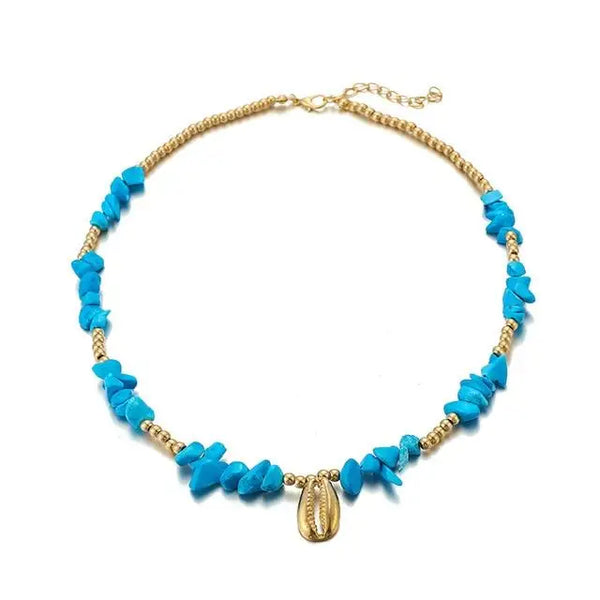
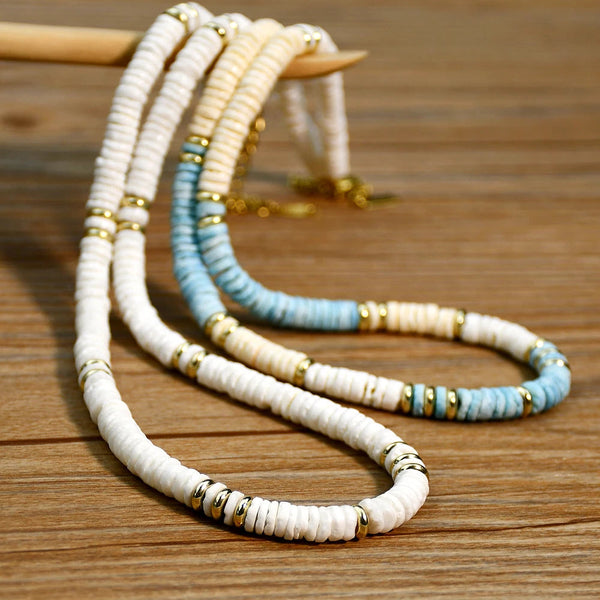
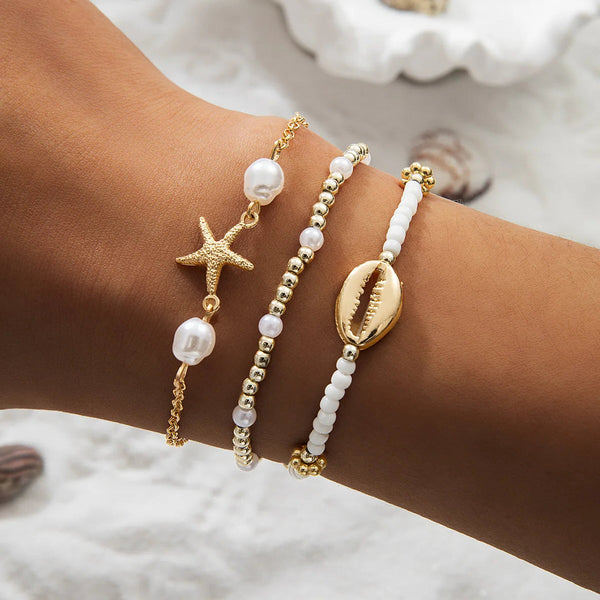
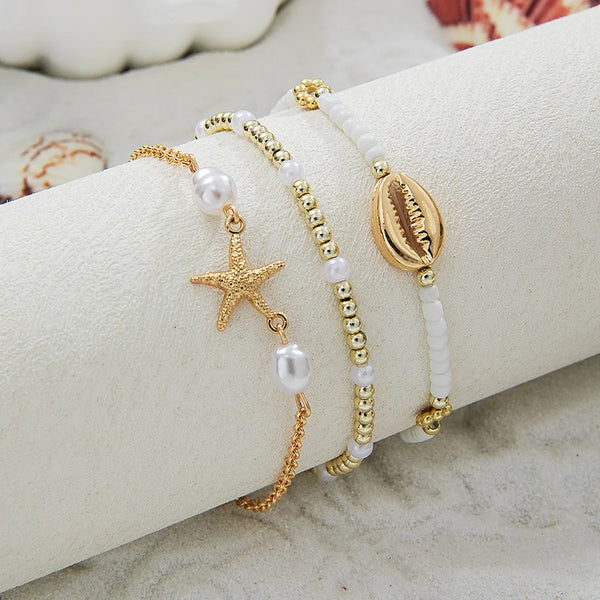
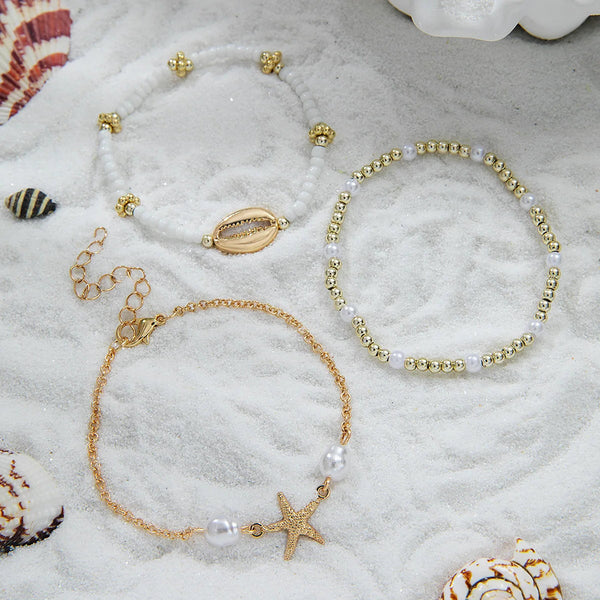
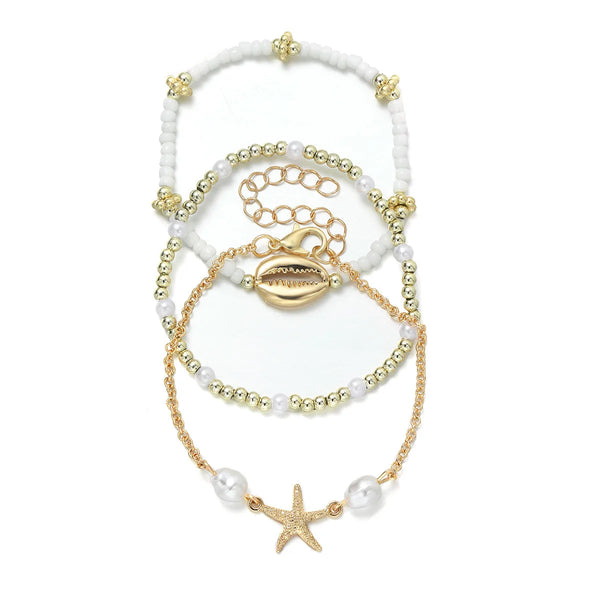
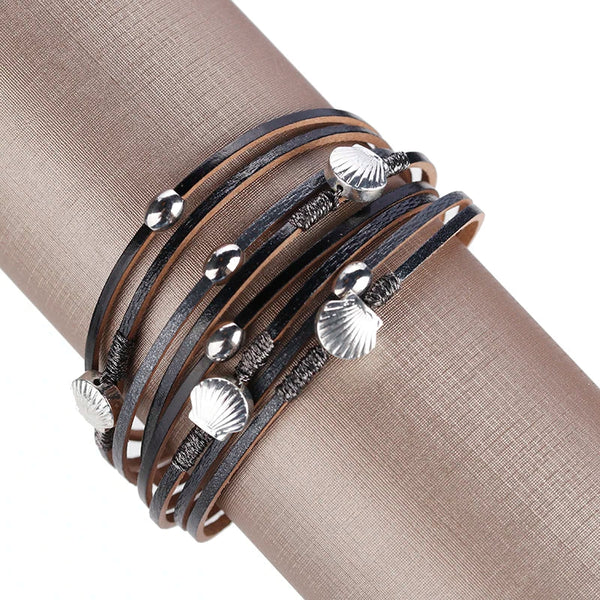
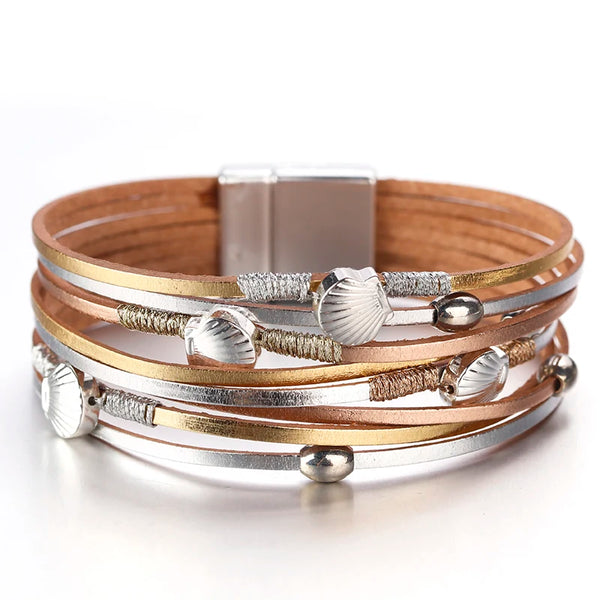
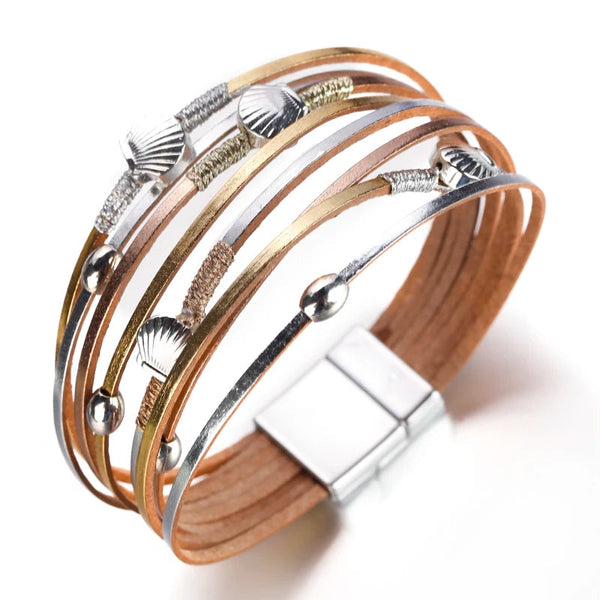
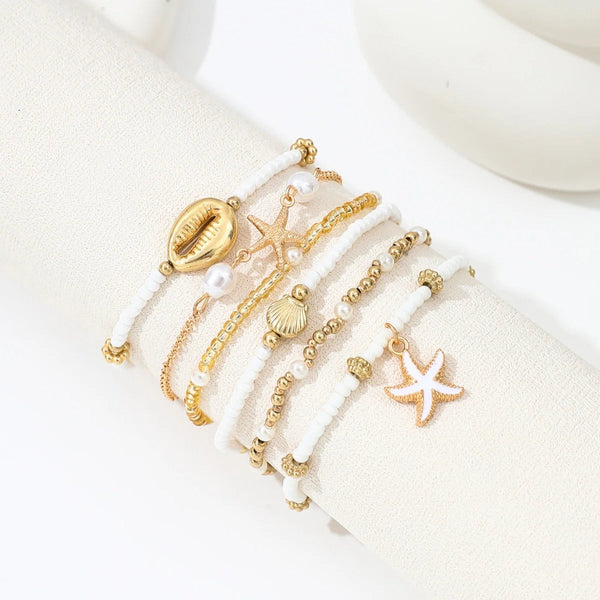
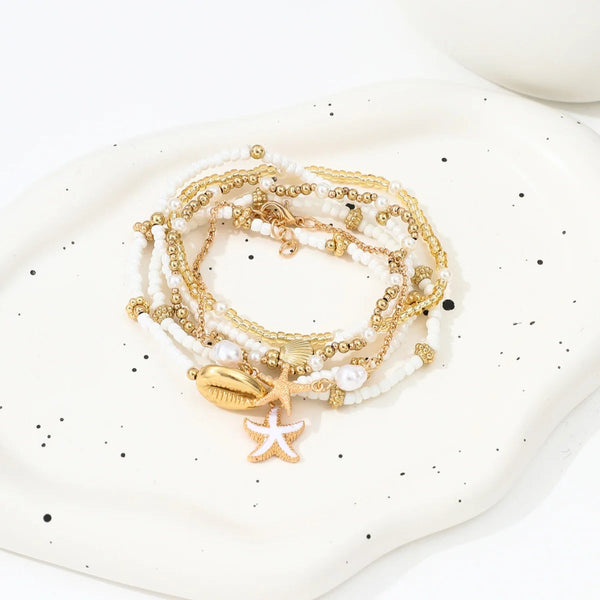
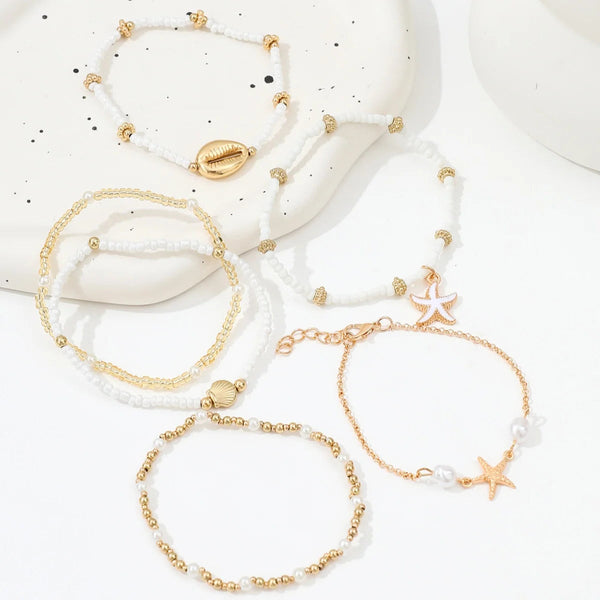
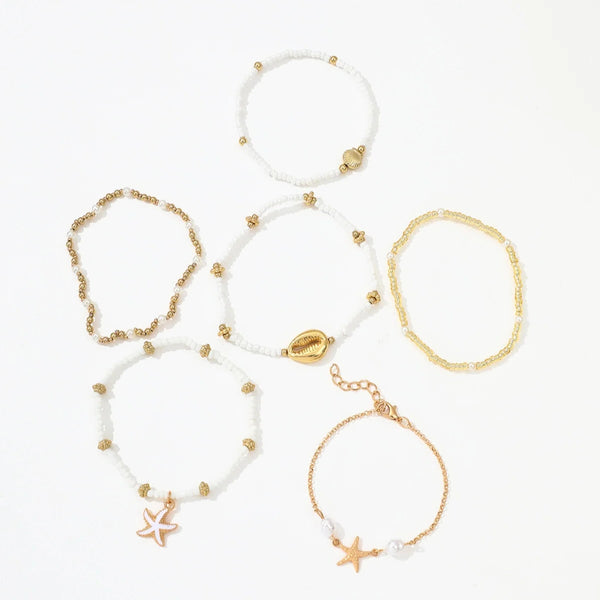
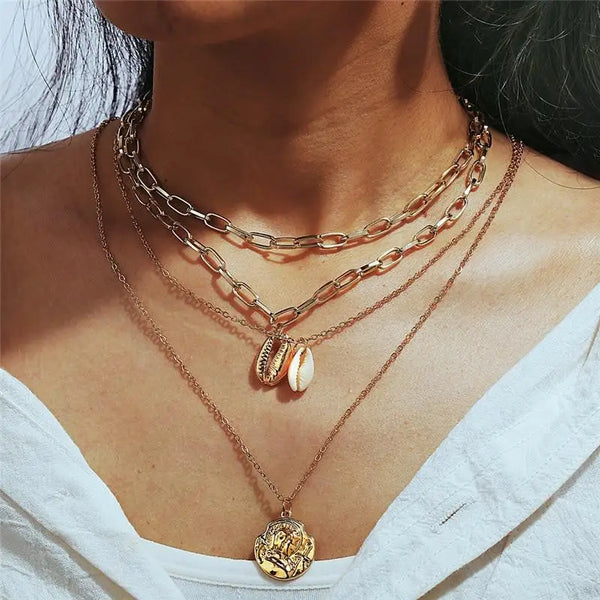
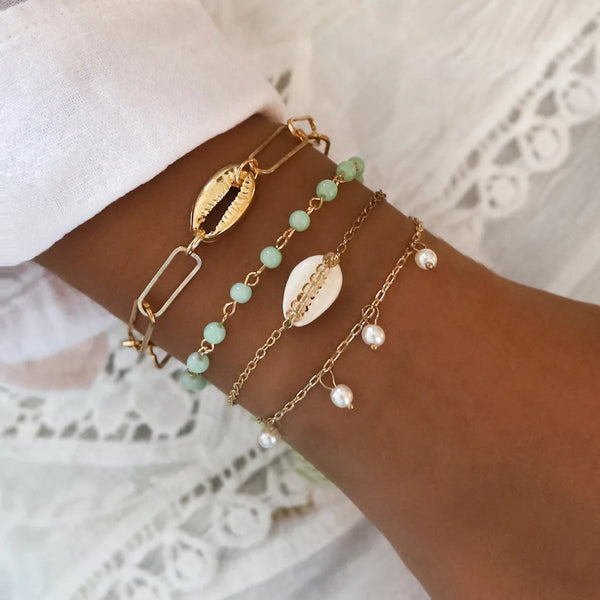
The Stack is Essential: Do not wear one shell bracelet. It looks lonely. You must stack. Mix a chunky Coastal Dream Shell Bracelet Set with a thin gold chain and a woven silk cord. You want the contrast. You want the clash between the manufactured metal (industrial) and the organic shell (natural). It tells a story of the ancient and the modern colliding on your wrist.

Texture Play: Shells look cheap against polyester. They need natural fibers to breathe. Pair your shell jewelry with heavy linen, raw silk, and wool. Think of the Roman matron in her stola—loose, draped, comfortable. A white shell bracelet pops aggressively against a rust-colored linen blazer. It’s sophisticated, not beachy.
The Color Palette: Stick to the Mediterranean triad: Terracotta, Olive, and Cerulean. We aren't going for "surfer girl" vibes here. We are going for "archaeologist on holiday." If you wear neon, the shell looks like a souvenir. If you wear earth tones, the shell looks like an artifact.
 Curate Your Legacy
Explore our full range of historical-inspired pieces.
Shop The Mediterranean wiht this Aegan spirit setCare Rituals: Respecting the Organic
A shell is not a diamond. It is alive in a different way, and it requires a relationship. If you treat it like plastic, it will lose its luster and its energy. You must tend to it.
The Salt Bath: Once a month, return your shell to its home. Mix sea salt with warm water in a glass bowl and let the bracelet soak for ten minutes. This isn't just cleaning the physical grime of the city; in metaphysical circles, this "resets" the energetic protection of the shell. It washes away the psychic debris it has absorbed for you.
Oil Feeding: Shells are porous. They can dry out and become brittle in our air-conditioned homes. Every few months, take a drop of olive oil or jojoba oil on your finger and rub it into the surface. Watch it drink the moisture. It will glow with a renewed depth, darker and richer than before.
Moonlight Charging: Ancient priestesses charged their tools under the full moon. Place your bracelet on a windowsill overnight when the moon is full. It sounds esoteric, but try it. The calcium carbonate structure reacts to light and temperature. You will find it feels different the next morning—cooler, heavier, more vibrant.
Frequently Asked Questions
What is the oldest shell jewelry ever found?
The oldest known shell jewelry consists of Nassarius shell beads found at Skhul Cave in Israel, dating back approximately 100,000 to 135,000 years. These tiny sea snails were perforated to be worn, predating other forms of art and suggesting symbolic thinking existed much earlier than previously thought.
Did Romans wear shell bracelets?
Yes. Romans valued pearls and shells highly, associating them with Venus (Aphrodite). While pearls were for the ultra-wealthy, carved shell cameos and bracelets were common status symbols for free citizens, often used as protective amulets for women and children.
What is the spiritual meaning of wearing shells?
Spiritually, shells represent the water element, intuition, and the feminine womb. They are widely used for protection against the Evil Eye and to promote emotional clarity. They are seen as vessels that can contain and transmute negative energy.
Why was Spondylus shell so valuable in the Neolithic era?
Spondylus was valued for its vibrant color, durability, and exotic origin. For inland European tribes, it represented a connection to the distant, mythical sea. It was traded like currency, often buried with gold in high-status graves, and its harvest required dangerous diving, adding to its prestige.
How do I clean my shell jewelry safely?
Never use harsh chemicals or ultrasonic cleaners on shell. Use a mild soap and warm water with a soft brush. To maintain the luster, occasionally rub a small amount of mineral or olive oil into the shell to prevent it from drying out and cracking.
Final Thoughts: The Echo of the Sea
When you fasten a shell bracelet around your wrist, you are doing something profound. You are closing a loop that started thousands of years ago. You are listening to the same ocean that the Phoenicians sailed, the same waves that crashed against the walls of Troy, the same water that held the reflection of the first stars.
In a world of mass-produced plastic and digital noise, the shell is an anchor. It is real. It is imperfect. It has a soul. It reminds us that we are not just consumers; we are the latest chapter in a long, beautiful story of human adornment.
Think of the "Gold Man" in Varna. He could have taken anything with him into the dark. He chose the shell. He knew that gold belongs to the earth, but the shell belongs to the eternal flow of the tide.
Wear it with pride. You are protected. You are part of the lineage.
Would you like me to curate a specific "Spondylus & Gold" layering guide for your next newsletter to help your readers style these pieces?